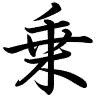
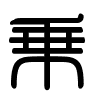
N4Tiểu học 3Tần suất: #254
Số nét9 nét
Thuộc bộ thủ丿
Loại chữCompound ideograph
Cấu trúc

Thứ tự nét & Thư pháp
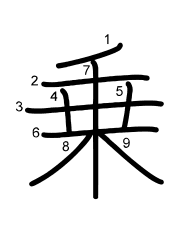
Thứ tự nét chữ 乗

Sơ đồ thứ tự viết các nét chữ Kanji.
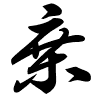
Biến thể Thư pháp cổ phong
Hành thưHành thư
Thảo thưThảo thư
Triện thưTriện thư

Thông số Unicode & Kỹ thuật

Unicode HexU+4E57
Unicode Decimal20055
Mã Braille (6 chấm)⠨⠦⠎
Mã Braille Kantenji⡕⢎

Đa ngôn ngữ & Biến thể

Phiên âm Pinyin tiếng TrungN/A
Phiên âm Hangul tiếng Hàn
Phiên âm Hán Việtthặng, thừa

Phiên âm Hán Việt

thặng, thừa
Các ý nghĩa đầy đủride; power; multiplication; record; counter for vehicles; board; mount; join; get on
Ý nghĩa chính thường dùngride; get on

Cách đọc

Âm On Katakana

ジョウ

Chi tiết: ジョウ(呉)、ショウ(漢)

Thống kê tần suất dùng:ジョウ(100%)

Âm Kun Hiragana

の(る)、の(せる)

Phân tích cấu trúc & Bộ phận

Thành phần cấu tạo
Từ các bộ thủ
Là thành phần trong các chữ Kanji khác

Các chữ dễ nhầm lẫn

Các chữ Kanji có cấu trúc hoặc nét viết tương tự:

Từ vựng & Từ ghép liên quan

Từ vựng đơn phổ biến
乗る
[godan verb, intransitive]:
{1} to get on (train, plane, bus, ship, etc.); to get in; to board; to take; to embark
{2} to get on (e.g. a footstool); to step on; to jump on; to sit on; to mount
{3} to reach; to go over; to pass
{4} to follow; to stay (on track); to go with (the times, etc.)
{5} to take part; to participate; to join
{6} to get into the swing (and sing, dance, etc.)
{7} to be deceived; to be taken in
{8} to be carried; to be spread; to be scattered
{9} to stick; to attach; to take; to go on
乗せる
せる
[ichidan verb, transitive]:
{1} to place on (something)
{2} to give (someone) a ride; to give a lift; to pick up; to help on board
{3} to load (luggage); to carry; to take on board
{4} to send out (on the airwaves, etc.)
{5} to deceive; to take for a ride
{6} to (sing) along with (musical accompaniment)
{7} to let (someone) take part
{8} to excite (someone)
乗じる
じょうじる
[ichidan verb, transitive, intransitive]:
{1} to take advantage of; to follow blindly
{2} (math) to multiply
ジョウ
[suffix]:
{1} (nth) power
{2} counter for vehicles
[noun]:
{3} multiplication
{4} (Buddhist term) Buddha's teachings
乗ずる
じょうずる
[ずる;じる verb, transitive]:
{1} to take advantage of; to follow blindly
{2} (math) to multiply
Từ ghép Kanji
乗組員
りくみいん
[noun]:
crew
搭乗
うじょう
[noun, する verb]:
embarkation; boarding (an aeroplane, airplane)
乗客
じょうきゃく
[noun]:
passenger
乗車
じょうしゃ
[noun, する verb]:
taking a train, bus, etc.; entraining
乗員
じょういん
[noun]:
crew
乗車券
じょうしゃけん
[noun]:
passenger ticket
乗用車
じょうようしゃ
[noun]:
passenger vehicle; automobile
乗務員
じょうむいん
[noun]:
crew member; crewman
乗降
じょうこう
[noun, する verb]:
getting on and off; embarking and disembarking
乗馬
じょうば
[noun, する verb, の adjective]:
{1} horse riding
[noun]:
{2} riding horse; saddle horse
同乗
うじょう
[noun, する verb]:
riding together; riding with
便乗
んじょう
[noun, する verb]:
taking advantage of a ride or an opportunity; taking a ship
Động từ ghép
乗り出す
りだ
{1} to set out; to set sail
{2} to embark on (a new venture); to set out (to achieve something)
{3} to begin to ride
{4} to lean forward
乗り込む
りこ
{1} to board; to embark on; to get into (a car); to man (a ship); to help (someone) into
{2} to march into; to enter
名乗り出る
のりで
to introduce oneself; to announce oneself (e.g. as the person sought); to come forward (e.g. as a witness, with a claim, etc.)
乗り回す
りまわ
to drive (a car) around; to ride (a bicycle) around
乗り越す
りこ
to ride past; to pass; to outdistance

Câu ví dụ minh họa

ポットとティーセットが()った、(ちい)さなカートを()して、セイカちゃんが(へや)(はい)ってきた。

Seika came into the room pushing a small cart with a pot and a tea set resting on it.

Kanji trong câu
Độ khóLớp 9 (THCS)
Từ chính乗る
Trợ từ
このらくだは(ひと)によくなれているからだれが()っても(だいじょうぶ)です。

This camel is so tame that anyone can ride it.

Kanji trong câu
Độ khóLớp 6 (Tiểu học)
Từ chính乗る
Trợ từ
(ひこうき)には150(めい)(じょうきゃく)()っていた。

There were 150 passengers on the plane.

Kanji trong câu
Độ khóLớp 9 (THCS)
Từ chính乗る
Trợ từ
(かのじょ)()るとすぐに、(れっしゃ)(えき)(しゅっぱつ)した。

As soon as she got on the train, it pulled out of the station.

Kanji trong câu
Độ khóLớp 10 (THPT)
Từ chính乗る
Trợ từ
(かれ)らといっしょに(かがくしゃ)たちの(いちぎょう)()っていた。

A party of scientists were on board with them.

Kanji trong câu
Độ khóLớp 10 (THPT)
Từ chính乗る
Trợ từ
(おお)くの(くにぐに)(しつぎょう)(もんだい)(くる)しんでいる。すなわちそこには(しょうらい)(ほしょう)されず、(じんせい)という(きしゃ)()(おく)れてしまう(おお)くの(わかもの)(たち)がいる。

There are many countries that are suffering unemployment. In other words, there are many young people that are not guaranteed a future and are late for the train called life.

Độ khóLớp 11 (THPT)
Từ chính保障
Trợ từ
(れっしゃ)(ていし)したので、(じょうきゃく)はみんなどうしたのかと(おも)った。

As the train came to a halt, all of the passengers wondered what was happening.

Kanji trong câu
Độ khóLớp 9 (THCS)
Từ chính停止
Trợ từ
(じょうきゃく)()(ここち)にはあまり(ちゅうい)(はら)われていなかった。

Little attention was paid to the comfort for the passengers.

Kanji trong câu
Độ khóTrên THPT
Từ chính払う
Trợ từ
(きたい)()(はじ)めて(じょうきゃく)(ふあん)になった。

Passengers became nervous when the plane began to vibrate.

Kanji trong câu
Độ khóLớp 10 (THPT)
Từ chính揺れる
Trợ từ
(わたし)たちが(とうじょう)した(ひこうき)はサンフランシスコ()きだった。

The plane we boarded was bound for San Francisco.

Kanji trong câu
Độ khóLớp 10 (THPT)
Từ chính搭乗
Trợ từ
(かれ)(どりょく)のおかげで、(のりくみいん)(ぜんいん)(きゅうじょ)された。

Thanks to his efforts, all the crew were saved.

Độ khóLớp 7 (THCS)
Từ chính救助
Trợ từ
(のりくみいん)(ぜんいん)(きゅうじょ)された。

The whole crew was saved.

Kanji trong câu
Độ khóLớp 12 (THPT)
Từ chính救助
Trợ từ
(おお)きな(じょうようしゃ)()まり、()(たか)(じょせい)()りた。

A big car drew up and a tall lady got out.

Độ khóLớp 4 (Tiểu học)
Từ chính止まる
Trợ từ
その(ついらく)(じこ)で400(にん)もの(じょうきゃく)(しぼう)した。

As many as 400 passengers were killed in the crash.

Độ khóLớp 10 (THPT)
Từ chính死亡
Trợ từ
バスががけから(てんらく)し、()っていた10(めい)(ぜんいん)(しぼう)した。

The bus fell off the cliff, killing all 10 aboard.

Kanji trong câu
Độ khóLớp 11 (THPT)
Từ chính死亡
Trợ từ