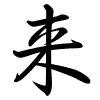
N5Tiểu học 2Tần suất: #59
Số nét7 nét
Thuộc bộ thủ
Loại chữPictograph
Cấu trúc

Thứ tự nét & Thư pháp
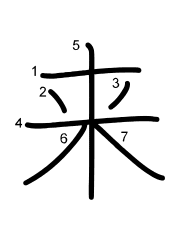
Thứ tự nét chữ 来

Sơ đồ thứ tự viết các nét chữ Kanji.

Biến thể Thư pháp cổ phong
Hành thưHành thư
Thảo thưThảo thư
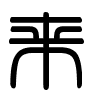
Triện thưTriện thư

Thông số Unicode & Kỹ thuật

Unicode HexU+6765
Unicode Decimal26469
Mã Braille (6 chấm)⠨⠑⠣
Mã Braille Kantenji⢇⡊

Đa ngôn ngữ & Biến thể

Phiên âm Pinyin tiếng Trunglái
Phiên âm Hangul tiếng Hàn
Phiên âm Hán Việtlai, lãi
Giản thể
Phồn thể

Phiên âm Hán Việt

lai, lãi
Các ý nghĩa đầy đủcome; due; next; cause; become
Ý nghĩa chính thường dùngcome

Cách đọc

Âm On Katakana

ライ

Chi tiết: ライ(呉)、タイ

Thống kê tần suất dùng:ライ(100%)

Âm Kun Hiragana

く(る)、きた(る)、きた(す)

Chi tiết: く(る)、きた(る)、きた(す)、き(たす)、き(たる)、き、こ、こ(し)、き(し)

Phân tích cấu trúc & Bộ phận

Thành phần cấu tạo
Từ các bộ thủ
Là thành phần trong các chữ Kanji khác

Từ vựng & Từ ghép liên quan

Từ vựng đơn phổ biến
来る
[godan verb, intransitive]:
{1} to come; to arrive; to be due to
[pre-noun adjectival (attributive)]:
{2} next (e.g. next April); forthcoming; coming
来る
[irregular godan verb, intransitive, auxiliary verb]:
{1} to come (spatially or temporally); to approach; to arrive
{2} to come back; to do ... and come back
{3} to come to be; to become; to get; to grow; to continue
{4} to come from; to be caused by; to derive from
{5} to come to (i.e. when it comes to spinach ...)
ライ
[noun]:
{1} next (year, etc.)
{2} since (last month, etc.)
来す
[godan verb, transitive]:
to cause; to induce; to bring about a result or state; to produce
Từ ghép Kanji
本来
んらい
[adverbial noun, temporal noun, の adjective]:
{1} originally; primarily
{2} essentially; naturally; by nature; in (and of) itself
{3} proper; legal
由来
らい
[adverb, noun, する verb]:
origin; source; history; derivation; reason; destiny
従来
じゅうらい
[adverbial noun, temporal noun]:
{1} up to now; so far
[の adjective]:
{2} traditional; conventional; usual; existing
以来
らい
[adverbial noun, temporal noun]:
since; henceforth
元来
んらい
[adverbial noun]:
originally; primarily; essentially; logically; naturally
古来
らい
[の adjective, adverb, noun]:
from time immemorial; ancient; time-honoured; time-honored
到来
うらい
[noun, する verb]:
arrival
将来
しょうらい
[adverbial noun, temporal noun]:
future (usually near); prospects
渡来
らい
[noun, する verb]:
visit; introduction; importation
未来
らい
[noun, の adjective]:
{1} the future (usually distant)
{2} future tense
{3} the world to come
往来
うらい
[noun, する verb]:
coming and going; road; correspondence; street traffic; highway
来訪
いほう
[noun, する verb]:
visit; call
旧来
きゅうらい
[の adjective, adverbial noun, temporal noun]:
traditional; from ancient times; formerly
来賓
いひん
[noun]:
guest; visitor; visitor's arrival
来日
いにち
[noun, する verb]:
arrival in Japan; coming to Japan; visit to Japan
Động từ ghép
出来上がる
きあがる
{1} to be completed; to be finished; to be ready (e.g. to serve or eat)
{2} to be very drunk

Câu ví dụ minh họa

(はや)くビールを()って()い、のどが(かわ)いているんだ。

Make with the beers, I'm thirsty!

Kanji trong câu
Độ khóLớp 5 (Tiểu học)
Từ chính乾く
Trợ từ
(わたし)たちが(よき)していた3(ばい)(ひとびと)がやって()た。

We got three times as many people as we expected.

Kanji trong câu
Độ khóLớp 5 (Tiểu học)
Từ chính予期
Trợ từ
(しょうらい)(なに)()こるか(だれ)(よげん)できるか。

Who can predict what will happen in the future?

Kanji trong câu
Độ khóLớp 12 (THPT)
Từ chính予言
Trợ từ
(できごと)(かれ)(よげん)したとおりに(てんかい)した。

The events unfolded just as she predicted.

Kanji trong câu
Độ khóTrên THPT
Từ chính予言
Trợ từ
ここへ()るといつも(こころ)(やす)まります。

Whenever I come here, I feel at ease.

Kanji trong câu
Độ khóLớp 5 (Tiểu học)
Từ chính休まる
Trợ từ
また、「(あんらく)いすに(すわ)りながらの()(もの)」には、(ざっとう)(こうつう)から()るフラストレーションが(ともな)わない。

Also, "armchair shopping" gets rid of the frustrations of crowds and traffic.

Độ khóLớp 12 (THPT)
Từ chính伴う
Trợ từ
(おお)くの(くにぐに)(しつぎょう)(もんだい)(くる)しんでいる。すなわちそこには(しょうらい)(ほしょう)されず、(じんせい)という(きしゃ)()(おく)れてしまう(おお)くの(わかもの)(たち)がいる。

There are many countries that are suffering unemployment. In other words, there are many young people that are not guaranteed a future and are late for the train called life.

Độ khóLớp 11 (THPT)
Từ chính保障
Trợ từ
(わく)(できあ)がると、クモはちょうど(じてんしゃ)(しゃりん)のやのように、それに(きぬ)(いと)をかける。

When the frame is finished, the spider fixes lines of silk across it, just like the spokes of a bicycle wheel.

Độ khóLớp 4 (Tiểu học)
Từ chính出来上がる
Trợ từ
(けいかく)(できあ)がった。

The plans have been drawn up.

Kanji trong câu
Độ khóLớp 11 (THPT)
Từ chính出来上がる
Trợ từ
(とつぜん)(こくじん)(はくじん)がお(たが)いに(はげ)しく(ぼうりょく)をふるい(にく)しみ()(じき)(とうらい)した。

Suddenly, there was a period of terrible violence and hatred between blacks and whites.

Độ khóLớp 10 (THPT)
Từ chính到来
Trợ từ
(かのじょ)(たす)けてくれるのをいつも()てに(でき)る。

You can always depend upon her to help.

Kanji trong câu
Độ khóTrên THPT
Từ chính助ける
Trợ từ
(ふゆ)()り、(はる)()た。

Winter has gone. Spring has come.

Kanji trong câu
Độ khóLớp 3 (Tiểu học)
Từ chính去る
Trợ từ
ジョージ、()()いたらいつでも(たず)ねて()(くだ)さい。

Just come to see me any time you feel like it, George.

Kanji trong câu
Độ khóLớp 5 (Tiểu học)
Từ chính向く
Trợ từ
これらはどちらも”(いし)(みらい)”と()ばれるもので、(しゅご)(いと)(ふく)まれています。

These are both called "future volitional" and include the intent of the subject.

Độ khóTrên THPT
Từ chính含む
Trợ từ
あなたが()べば、(かれ)()るでしょう。

He will come if you call him.

Kanji trong câu
Độ khóLớp 6 (Tiểu học)
Từ chính呼ぶ
Trợ từ