N4Tiểu học 2Tần suất: #354
Số nét8 nét
Thuộc bộ thủ
Loại chữPictograph
Cấu trúc

Thứ tự nét & Thư pháp

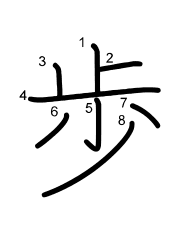
Thứ tự nét chữ 歩

Sơ đồ thứ tự viết các nét chữ Kanji.

Biến thể Thư pháp cổ phong
Hành thưHành thư
Thảo thưThảo thư
Triện thưTriện thư

Thông số Unicode & Kỹ thuật

Unicode HexU+6B69
Unicode Decimal27497
Mã Braille (6 chấm)⠰⠮⠁
Mã Braille Kantenji⣡⢼

Đa ngôn ngữ & Biến thể

Phiên âm Pinyin tiếng TrungN/A
Phiên âm Hangul tiếng Hàn
Phiên âm Hán Việtbộ

Phiên âm Hán Việt

bộ
Các ý nghĩa đầy đủwalk; counter for steps
Ý nghĩa chính thường dùngwalk

Cách đọc

Âm On Katakana

ホ、ブ、フ*

Chi tiết: ホ(漢)、ブ(呉)、フ(慣)

Thống kê tần suất dùng:フ(62.5%), ブ(22.5%), ホ(15%)

Âm Kun Hiragana

ある(く)、あゆ(む)

Phân tích cấu trúc & Bộ phận

Thành phần cấu tạo
Từ các chữ Kanji khác
Từ các bộ thủ
Là thành phần trong các chữ Kanji khác

Từ vựng & Từ ghép liên quan

Từ vựng đơn phổ biến
歩く
[godan verb, intransitive]:
to walk
[noun]:
(abbreviation) pawn (in chess or shogi)
[noun]:
unit of land measurement; 3.95 square yards; 3.31 square metres (meters)
[noun]:
{1} step; stride
{2} counter for steps
歩む
[godan verb, intransitive]:
to walk; to go on foot
歩み
ゆみ
[noun]:
{1} walking
{2} progress; advance
Từ ghép Kanji
徒歩
[noun, の adjective]:
walking; going on foot
散歩
んぽ
[noun, する verb]:
walk; stroll
歩兵
へい
[noun]:
infantry; infantryman; foot soldier
譲歩
じょうほ
[noun, する verb, の adjective]:
concession; conciliation; compromise
進歩
んぽ
[noun, する verb]:
progress; advance; improvement; development
歩道
どう
[noun]:
footpath; walkway; sidewalk
一歩
っぽ
[adverbial noun, temporal noun]:
{1} (a) step
{2} level; stage
{3} small degree; small amount
歩行者
うしゃ
[noun]:
pedestrian; walker
歩行
こう
[noun, する verb]:
walk
第一歩
いいっぽ
[noun]:
first step
歩道橋
どうきょう
[noun]:
pedestrian bridge
歩合
あい
[noun]:
rate; ratio; commission; percentage; poundage
Động từ ghép
歩み寄る
ゆみよる
to step up; to compromise; to meet halfway
歩き回る
るきまわる
to walk about; to walk to and fro; to pace around

Câu ví dụ minh họa

(かれ)(もど)ってきた(とき)には、(おんな)(あゆ)()っていた。

When he came back, the woman had walked off.

Kanji trong câu
Độ khóTrên THPT
Từ chính戻る
Trợ từ
(えき)(ちか)くの(ほどう)には(どこ)()ってもおびただしい(かず)(じてんしゃ)(ほうち)されているのが()かけられる。

Wherever you go, you see a lot of bicycles left on sidewalks near stations.

Độ khóLớp 8 (THCS)
Từ chính放置
Trợ từ
(せんせい)()るよ。(ある)(かた)がとてもゆっくりだね。

There comes our teacher. He is walking very slowly.

Kanji trong câu
Độ khóLớp 3 (Tiểu học)
Từ chính来る
Trợ từ
(いま)では(こうつう)(きかん)(はったつ)したため、(ある)(ひと)(すく)ないのは(いかん)である。

It is regrettable that few people should walk today because of the development of traffic facilities.

Độ khóLớp 10 (THPT)
Từ chính発達
Trợ từ
(ほどう)にお(かね)()ちていた。

I found a coin on the sidewalk.

Kanji trong câu
Độ khóLớp 8 (THCS)
Từ chính落ちる
Trợ từ
(かがく)(しんぽ)すれば、このような(もんだい)(かいけつ)(でき)るようになる。

If science makes progress, we'll be able to solve such problems.

Độ khóLớp 12 (THPT)
Từ chính進歩
Trợ từ
(かがく)(しんぽ)すると、(ふる)(しゅうかん)(あたら)しいものに()って()わられる。

As science makes progress, old ways give place to new.

Độ khóTrên THPT
Từ chính進歩
Trợ từ
(かれ)(あめ)()(いがい)(まいにち)(とほ)(しゅっきん)します。

He goes to work on foot every day except on rainy days.

Độ khóLớp 8 (THCS)
Từ chính出勤
Trợ từ
よちよち(ある)きの(ようじ)でもできるのだから(かぞく)(たの)しんでいただきたい。

Even toddlers can do it, so I'd like you to enjoy yourselves as a family.

Kanji trong câu
Độ khóLớp 8 (THCS)
Từ chính楽しむ
Trợ từ
(じんるい)は2(ほん)(あし)(ある)きます。

Humans walk on two feet.

Kanji trong câu
Độ khóLớp 7 (THCS)
Từ chính歩く
Trợ từ
(かれ)はその(しょうふ)()もくれない(ようす)(ある)いていった。

He walked on appearing to disregard the prostitute.

Kanji trong câu
Độ khóLớp 5 (Tiểu học)
Từ chính歩く
Trợ từ
(ろうじん)がたどたどしい(あしど)りで(ある)いてきた。

An old man came tottering along.

Kanji trong câu
Độ khóLớp 3 (Tiểu học)
Từ chính歩く
Trợ từ
(よみち)(ひとり)(ある)くのは(きけん)だと(おも)います。

I think it dangerous walking alone at night.

Kanji trong câu
Độ khóLớp 6 (Tiểu học)
Từ chính歩く
Trợ từ
(かれ)らは(うで)をくんで(ある)いてきた。

They came walking arm in arm.

Kanji trong câu
Độ khóLớp 8 (THCS)
Từ chính歩く
Trợ từ
(わたし)(こお)った(ほどう)(すべ)って(ころ)んだ。

I slipped and fell on the icy sidewalk.

Kanji trong câu
Độ khóTrên THPT
Từ chính滑る
Trợ từ