N4Tiểu học 2Tần suất: #58
Số nét10 nét
Thuộc bộ thủ
Loại chữPhono-semantic compound
Cấu trúc

Thứ tự nét & Thư pháp
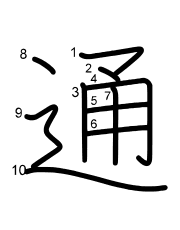
Thứ tự nét chữ 通

Sơ đồ thứ tự viết các nét chữ Kanji.

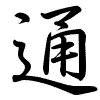
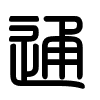
Biến thể Thư pháp cổ phong
Hành thưHành thư
Thảo thưThảo thư
Triện thưTriện thư

Thông số Unicode & Kỹ thuật

Unicode HexU+901A
Unicode Decimal36890
Mã Braille (6 chấm)⠨⠝⠎
Mã Braille Kantenji⣃⡺

Đa ngôn ngữ & Biến thể

Phiên âm Pinyin tiếng Trungtōng,tòng
Phiên âm Hangul tiếng Hàn
Phiên âm Hán Việtthông
Giản thể
Phồn thể

Phiên âm Hán Việt

thông
Các ý nghĩa đầy đủtraffic; pass through; avenue; commute; counter for letters, notes, documents, etc.; pass; communicate
Ý nghĩa chính thường dùngtraffic; pass; communicate; pass through

Cách đọc

Âm On Katakana

ツウ、ツ*

Chi tiết: ツウ(呉)、ツ(漢)、トウ(漢)

Thống kê tần suất dùng:ツウ(50%), ツ(50%)

Âm Kun Hiragana

とお(る)、とお(す)、かよ(う)

Chi tiết: とお(る)、とお(り)、とお(す)、とお(し)、かよ(う)

Phân tích cấu trúc & Bộ phận

Thành phần cấu tạo
Từ các chữ Kanji khác
Từ các bộ thủ
Là thành phần trong các chữ Kanji khác

Các chữ dễ nhầm lẫn

Các chữ Kanji có cấu trúc hoặc nét viết tương tự:

Từ vựng & Từ ghép liên quan

Từ vựng đơn phổ biến
通り
おり
[adverbial noun, noun]:
{1} avenue; street; way; road
{2} coming and going; street traffic
{3} flow (of water, air, etc.)
{4} transmission (of sound); reach (e.g. of voice)
{5} fame; reputation; popularity
{6} the same status or way; as (e.g. as expected, as I said)
{7} understanding; comprehension
{8} counter for sets of things; counter for methods, ways, types
通る
おる
[godan verb, intransitive]:
{1} to go by; to go past; to go along; to travel along; to pass through; to use (a road); to take (a route); to go via; to go by way of
{2} to run (between); to operate (between); to connect
{3} to go indoors; to go into a room; to be admitted; to be shown in; to be ushered in; to come in
{4} to penetrate; to pierce; to skewer; to go through; to come through
{5} to permeate; to soak into; to spread throughout
{6} to carry (e.g. of a voice); to reach far
{7} to be passed on (e.g. of a customer's order to the kitchen); to be relayed; to be conveyed
{8} to pass (a test, a bill in the House, etc.); to be approved; to be accepted
{9} to go by (a name); to be known as; to be accepted as; to have a reputation for
{10} to be coherent; to be logical; to be reasonable; to be comprehensible; to be understandable; to make sense
{11} to get across (e.g. of one's point); to be understood
{12} to be straight (e.g. wood grain)
{13} (archaism) to be well-informed; to be wise
[suffix, godan verb]:
{14} to do ... completely; to do ... thoroughly
通す
おす
[godan verb, transitive]:
{1} to stick through; to force through
{2} to spread throughout; to thoroughly diffuse
{3} to make a path between two points
{4} to proceed in a logical manner
{5} to let pass; to allow through
{6} to lead (someone) into (a house, room, etc.); to show in
{7} to go through (a middleman)
{8} to (look, listen) through (a window, wall, etc.)
{9} to pass (a law, applicant, etc.)
{10} to force to accept; to force agreement
{11} to continue (in a state); to persist in
{12} to do to the entirety of; to cover all of; to span the whole ...
{13} to do from beginning to end without a break
{14} to convey (one's ideas, etc.) to the other party
{15} (after the -te form of a verb) to do to the end; to carry through; to complete
通じる
うじる
[ichidan verb, intransitive, transitive]:
{1} to be open (to traffic); to lead to; to communicate (with)
{2} to flow (liquid, current); to pass; to get through to
{3} to be understood; to be comprehended
{4} to be honored; to be good
{5} to be well versed in; to be well-informed
{6} to communicate clandestinely; to keep in touch (e.g. with the enemy)
{7} to form a liaison; to be intimate
通う
よう
[godan verb, intransitive]:
{1} to go back and forth; to ply between
{2} to commute; to attend (school, church, etc.)
ツウ
[な adjective, noun]:
{1} connoisseur; authority
{2} counter for letters, notes, documents, etc.
通ずる
うずる
[ずる;じる verb, intransitive, transitive]:
{1} to be open (to traffic); to lead to; to communicate (with)
{2} to flow (liquid, current); to pass; to get through to
{3} to be understood; to be comprehended
{4} to be honored; to be good
{5} to be well versed in; to be well-informed
{6} to communicate clandestinely; to keep in touch (e.g. with the enemy)
{7} to form a liaison; to be intimate
通い
よい
[noun]:
coming and going; commuting
通し
おし
[noun]:
{1} direct; right through; straight
{2} appetizer; appetiser
{3} (abbreviation) performance of an entire play
Từ ghép Kanji
通常
うじょう
[の adjective, adverbial noun, temporal noun]:
common; general; normal; usual
通称
うしょう
[noun, する verb]:
popular name; nickname; alias
通信販売
うしんはんばい
[noun, の adjective]:
mail order; mail-order sales; shop-by-mail service; on-line shopping service (with delivery by mail)
通販
うはん
[noun, する verb, の adjective]:
(abbreviation) mail order
普通
つう
[の adjective]:
{1} general; ordinary; usual
[adverb]:
{2} normally; generally; usually
{3} (abbreviation) train that stops at every station
共通
きょうつう
[な adjective, noun, の adjective]:
{1} commonness; community
[する verb]:
{2} to be common; to be shared
[noun used as a suffix]:
{3} -wide
通過
うか
[noun, する verb]:
{1} passage through (e.g. train skipping a station); transit
{2} passing (e.g. exam, bill through parliament)
交通
うつう
[noun, する verb]:
traffic; transportation; communication; exchange (of ideas, etc.); intercourse
交通事故
うつうじ
[noun]:
traffic accident
流通
りゅうつう
[noun, する verb, の adjective]:
{1} circulation of money or goods; flow of water or air; distribution
[adjectival (prenominal) form]:
{2} negotiable (e.g. shares)
通算
うさん
[noun, する verb]:
total
通信
うしん
[noun, する verb]:
correspondence; communication; transmission; news; signal
通知
うち
[noun, する verb]:
notice; notification; report; posting
通訳
うやく
[noun, する verb]:
interpretation (i.e. oral translation); interpreter
通勤
うきん
[noun, する verb]:
commuting to work
Động từ ghép
通り過ぎる
おりすぎ
to pass; to pass through
透き通る
きとおる
to be(come) transparent

Câu ví dụ minh họa

(とお)りに沿()って(みせ)(なら)んでいる。

There are stores along the street.

Kanji trong câu
Độ khóLớp 9 (THCS)
Từ chính並ぶ
Trợ từ
その(とお)りにはマジソン(だいとうりょう)()()けられている。

The street is named for President Madison.

Kanji trong câu
Độ khóLớp 12 (THPT)
Từ chính付ける
Trợ từ
また、「(あんらく)いすに(すわ)りながらの()(もの)」には、(ざっとう)(こうつう)から()るフラストレーションが(ともな)わない。

Also, "armchair shopping" gets rid of the frustrations of crowds and traffic.

Độ khóLớp 12 (THPT)
Từ chính伴う
Trợ từ
()(たお)れていて(みち)(とお)れなくなっていた。

The road was obstructed by fallen trees.

Kanji trong câu
Độ khóLớp 7 (THCS)
Từ chính倒れる
Trợ từ
(よどお)しうちの(いぬ)()えているのが()こえた。

I heard our dog barking all night.

Kanji trong câu
Độ khóLớp 4 (Tiểu học)
Từ chính吠える
Trợ từ
(こうつうじこ)(けんすう)(ぞうか)している。

The number of traffic accident is on the increase.

Kanji trong câu
Độ khóLớp 10 (THPT)
Từ chính増加
Trợ từ
(ちち)(ふつう)(わたし)()ているうちに(いえ)()ます。

My father usually leaves home while I am in bed.

Kanji trong câu
Độ khóLớp 7 (THCS)
Từ chính寝る
Trợ từ
(どうじ)(つうやく)によって(げんご)(しょうへき)(くず)れた。

Simultaneous translation broke linguistic walls.

Độ khóTrên THPT
Từ chính崩れる
Trợ từ
(むり)(とお)れば(どうり)()()む。

Might makes right.

Kanji trong câu
Độ khóLớp 9 (THCS)
Từ chính引っ込む
Trợ từ
いまやブッシュ(だいとうりょう)(とうせん)したのだから、(ぎょうむ)(つうじょう)(どお)りになるだろう。

Now that Bush has been elected, it will be business as usual.

Độ khóLớp 9 (THCS)
Từ chính当選
Trợ từ
それはちょうど(かのじょ)(いと)した(とお)りのことだった。

That was exactly what she intended.

Kanji trong câu
Độ khóLớp 10 (THPT)
Từ chính意図
Trợ từ
(ひと)つが(とお)()ぎたかと(おも)うと、すぐに(つぎ)(たいふう)(せっきん)する。

No sooner has one typhoon passed than the next one approaches.

Kanji trong câu
Độ khóLớp 5 (Tiểu học)
Từ chính接近
Trợ từ
(つうしん)(しゅだん)(きのう)しなくなった。

Communications broke down.

Kanji trong câu
Độ khóTrên THPT
Từ chính機能
Trợ từ
(れっしゃ)()んでいたので、(われわれ)(おおさか)までずっと()(とお)しだった。

The train was so crowded that we were obliged to stand all the way to Osaka.

Kanji trong câu
Độ khóLớp 8 (THCS)
Từ chính混む
Trợ từ
(けさ)(でんしゃ)()んでいて(くうせき)()つからなかったので、ずっと()(とお)しだった。

This morning the train was so crowded that I couldn't find a vacant seat and had to stand the whole way.

Độ khóLớp 9 (THCS)
Từ chính混む
Trợ từ