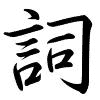
N2Tiểu học 6Tần suất: #1195
Số nét12 nét
Thuộc bộ thủ
Loại chữPhono-semantic compound
Cấu trúc

Thứ tự nét & Thư pháp
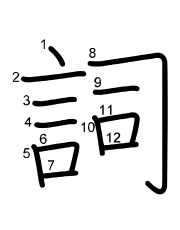
Thứ tự nét chữ 詞

Sơ đồ thứ tự viết các nét chữ Kanji.
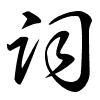
Biến thể Thư pháp cổ phong
Hành thưHành thư
Thảo thưThảo thư
Triện thưTriện thư

Thông số Unicode & Kỹ thuật

Unicode HexU+8A5E
Unicode Decimal35422
Mã Braille (6 chấm)⠢⠍⠅
Mã Braille Kantenji⠗⢘

Đa ngôn ngữ & Biến thể

Phiên âm Pinyin tiếng Trung
Phiên âm Hangul tiếng Hàn
Phiên âm Hán Việttừ
Giản thể
Phồn thể

Phiên âm Hán Việt

từ
Các ý nghĩa đầy đủpart of speech; words; poetry

Cách đọc

Âm On Katakana

Chi tiết: シ(漢)、ジ(呉)

Thống kê tần suất dùng:シ(100%)

Âm Kun Hiragana

None

Chi tiết: ことば

Phân tích cấu trúc & Bộ phận

Thành phần cấu tạo
Từ các chữ Kanji khác
Từ các bộ thủ

Câu ví dụ minh họa

(ほそく)(じょうほう)には、(ふくし)(ふくし)のはたらきをするものが(はい)ります。

Supplementary information includes adverbs and things that function as adverbs.

Kanji trong câu
Độ khóLớp 6 (Tiểu học)
Từ chính入る
Trợ từ
(めいし)から(どうし)(はせい)していることもあれば、その(ぎゃく)のこともある。

Sometimes a verb is derived from a noun and sometimes it is the other way around.

Kanji trong câu
Độ khóTrên THPT
Từ chính派生
Trợ từ
toのつかない(ふてい)(ことば)(げんけい)(ふてい)(ことば)()う。

An infinitive without a 'to' attached is called a bare infinitive.

Kanji trong câu
Độ khóTrên THPT
Từ chính言う
Trợ từ
(ぶんぽう)()()きたいんですが、「be+(ぶんし)」はV Cなどのように(かんが)えることはできないんですか?

I'd like to ask a grammarian, isn't it possible to think of 'be + participle' like you do V C and such?

Kanji trong câu
Độ khóLớp 7 (THCS)
Từ chính考える
Trợ từ
(ぶんぽう)()()きたいんですが、「be+(ぶんし)」はV

Cなどのように考えることはできないんですか? I'd like to ask a grammarian, isn't it possible to think of 'be + participle' like you do V C and such?

Kanji trong câu
Độ khóLớp 7 (THCS)
Từ chính考える
Trợ từ
(ぶんぽう)()()きたいんですが、「be+(ぶんし)」はV Cなどのように(かんが)えることはできないんですか?

I'd like to ask a grammarian, isn't it possible to think of 'be + participle' like you do V C and such?

Kanji trong câu
Độ khóLớp 7 (THCS)
Từ chính聞く
Trợ từ
(めいし)(しゅうしょく)するもの((けいようし)、または(けいようし)(そうとう)(ごく))。

Things that modify nouns (adjective, or adjectival equivalent).

Độ khóTrên THPT
Từ chính修飾
Trợ từ
(いんよう)した(もんだい)ではありませんが、(かんけい)(だいめいし)(かんけい)(ふくし)使(つか)()けを()(もんだい)がリーディングセクションにはあります。

The problem quoted isn't one, but there are problems in the reading section that ask you to distinguish relative pronouns from relative adverbs.

Độ khóLớp 6 (Tiểu học)
Từ chính問う
Trợ từ
(どうし)(じゅつご)(どうし)のことです。(じゅつご)(どうし)は、(しゅご)(あらわ)(とき)によって(かたち)()えます。

'Verb' refers to the predicate verb. Predicate verbs change their form depending on the subject and the time expressed.

Độ khóTrên THPT
Từ chính変える
Trợ từ
(えいご)(がくしゅう)する(うえ)(ふかけつ)な、(ふきそく)(どうし)(かつよう)

Conjugation of irregular verbs - essential for those learning English.

Độ khóLớp 8 (THCS)
Từ chính学習
Trợ từ
(かさん)(めいし)()(かさん)(めいし)かどちらかを(したが)えている(ひょうげん)(ふた)()け。

Write two expressions that are followed by either count or non-count nouns in conversation.

Độ khóTrên THPT
Từ chính従える
Trợ từ
(いま)(きほん)(てき)(ぶんし)(こうぶん)(おし)えているのですが、(みな)さんは(いか)(ぶんし)(こうぶん)(わけ)については、どのように(こと)なる(やく)(かた)をされますか?

I'm teaching basic participial constructions now, but, with regard to those below, what different ways of translating them would everybody use?

Độ khóLớp 9 (THCS)
Từ chính教える
Trợ từ
(ひんし)(りかい)することは、(ただ)しい(ごじゅん)(かんかく)()につけるうえで(ひじょう)(たいせつ)なことです。

Understanding parts-of-speech is extremely important for getting the feel of word order.

Độ khóLớp 7 (THCS)
Từ chính理解
Trợ từ
(せんこう)(ことば)がthis,that,these,thoseの(ばあい)はwhichを(もち)いるのが(ふつう)です。

When the antecedent is this, that, these or those it is usual to use 'which'.

Kanji trong câu
Độ khóLớp 11 (THPT)
Từ chính用いる
Trợ từ
この()では(ぜんちし)(しょうりゃく)できる。

You can omit the preposition in this phrase.

Kanji trong câu
Độ khóLớp 10 (THPT)
Từ chính省略
Trợ từ