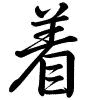
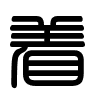
N4Tiểu học 3Tần suất: #183
Số nét12 nét
Thuộc bộ thủ
Loại chữCompound ideograph
Cấu trúc

Thứ tự nét & Thư pháp
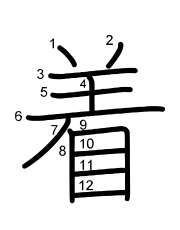
Thứ tự nét chữ 着

Sơ đồ thứ tự viết các nét chữ Kanji.
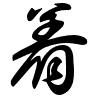
Biến thể Thư pháp cổ phong
Hành thưHành thư
Thảo thưThảo thư
Triện thưTriện thư

Thông số Unicode & Kỹ thuật

Unicode HexU+7740
Unicode Decimal30528
Mã Braille (6 chấm)⠠⠗⠝
Mã Braille Kantenji⣷⢼

Đa ngôn ngữ & Biến thể

Phiên âm Pinyin tiếng Trungzhāo,zháo,zhe,zhuó,zhù
Phiên âm Hangul tiếng Hàn
Phiên âm Hán Việthồ, trước, trứ, trữ
Giản thể
Phồn thể

Phiên âm Hán Việt

hồ, trước, trứ, trữ
Các ý nghĩa đầy đủdon; arrive; wear; counter for suits of clothing; put on; stick
Ý nghĩa chính thường dùngdon; put on; arrive; stick; wear

Cách đọc

Âm On Katakana

チャク、ジャク*

Chi tiết: チャク(漢)、ジャク(呉)

Thống kê tần suất dùng:ジャク(66.7%), チャク(33.3%)

Âm Kun Hiragana

き(る)、き(せる)、つ(く)、つ(ける)

Phân tích cấu trúc & Bộ phận

Thành phần cấu tạo
Từ các bộ thủ

Các chữ dễ nhầm lẫn

Các chữ Kanji có cấu trúc hoặc nét viết tương tự:

Từ vựng & Từ ghép liên quan

Từ vựng đơn phổ biến
着る
[ichidan verb, transitive]:
{1} to wear (in modern Japanese, from the shoulders down); to put on
{2} to bear (guilt, etc.)
着く
[godan verb, intransitive]:
{1} to arrive at; to reach
{2} to sit on; to sit at (e.g. the table)
チャク

{1} counter for suits of clothing

[suffix]:
{2} arriving at ...
着ける
[ichidan verb, transitive]:
{1} to attach; to join; to add; to append; to affix; to stick; to glue; to fasten; to sew on; to apply (ointment)
{2} to furnish (a house with)
{3} to wear; to put on
{4} to keep a diary; to make an entry
{5} to appraise; to set (a price)
{6} to bring alongside
{7} to place (under guard or doctor)
{8} to follow; to shadow
{9} to load; to give (courage to)
{10} to keep (an eye on)
{11} to establish (relations or understanding)
{12} to turn on (light)
着せる
せる
[ichidan verb, transitive]:
{1} to put clothes on (someone)
{2} to plate; to gild; to veneer
{3} to accuse (of some crime); to give (a bad name)
Từ ghép Kanji
装着
うちゃく
[noun, する verb]:
equipping; installing; mounting; laying down
到着
うちゃく
[noun, する verb, の adjective]:
arrival
定着
いちゃく
[noun, する verb]:
taking hold; getting attached; becoming established; fixing down; establishing
着用
ちゃくよう
[noun, する verb]:
wearing (e.g. uniform, seat belt); having on
発着
っちゃく
[noun, する verb]:
arrival and departure
執着
しゅうちゃく
[noun, する verb]:
attachment; adhesion; tenacity
着陸
ちゃくりく
[noun, する verb]:
landing; alighting; touch down
密着
っちゃく
[noun, する verb]:
{1} glued to; closely related to
{2} giving total coverage to the key figure(s) of a TV or film documentary
終着駅
しゅうちゃくえき
[noun]:
terminal station
漂着
ひょうちゃく
[noun, する verb]:
drifting ashore
肌着
だぎ
[noun]:
underwear; underclothes; lingerie; chemise; singlet
着手
ちゃくしゅ
[する verb]:
{1} to start work (on); to undertake
[noun]:
{2} embarkation; launch
決着
っちゃく
[noun, する verb]:
conclusion; decision; end; settlement
着工
ちゃっこう
[noun, する verb]:
start of (construction) work
着目
ちゃくもく
[noun, する verb]:
attention
Động từ ghép
落ち着く
ちつく
{1} to calm down; to compose oneself; to regain presence of mind
{2} to calm down; to settle down; to die down; to become stable; to abate
{3} to settle down (in a location, job, etc.); to settle in
{4} to be settled; to be fixed; to have been reached
{5} to harmonize with; to harmonise with; to match; to suit; to fit
{6} to be unobtrusive; to be quiet; to be subdued

Câu ví dụ minh họa

(かれ)(ふる)える()()()いた(たいど)(いつわ)りである(こと)(しめ)していた。

His trembling hands belied his calm attitude.

Độ khóTrên THPT
Từ chính偽る
Trợ từ
(しょうぼうしゃ)(とうちゃく)しないうちに、その(いえ)(まるや)けになった。

Before the fire engine arrived, the whole house was burnt down.

Kanji trong câu
Độ khóTrên THPT
Từ chính到着
Trợ từ
(じこ)があるとすぐに(きゅうきゅう)(いりょう)(たい)(とうちゃく)する。

Medical help arrives promptly after an accident.

Độ khóLớp 9 (THCS)
Từ chính到着
Trợ từ
(ふしょう)した(だんせい)(けいさつ)(とうちゃく)する(まえ)(どうろ)(よこ)たわっていた。

The injured man lay in the street before the police arrived.

Độ khóLớp 10 (THPT)
Từ chính到着
Trợ từ
(しなもの)(とうちゃく)しましたらご(れんらく)いたします。

I will notify you of the arrival of the goods.

Kanji trong câu
Độ khóLớp 6 (Tiểu học)
Từ chính到着
Trợ từ
(かのじょ)(ほうもん)(きゃく)(とうちゃく)する(まえ)(けしょう)をした。

She made herself up before her visitor arrived.

Độ khóLớp 10 (THPT)
Từ chính到着
Trợ từ
(ひと)(げつめん)(ちゃくりく)し、ベルリンでは(かべ)(ほうかい)し、われわれの(かがく)(そうぞう)(りょく)によって(せかい)はつながりました。

A man touched down on the moon. A wall came down in Berlin. A world was connected by our own science and imagination.

Độ khóLớp 10 (THPT)
Từ chính崩壊
Trợ từ
ついに(びょうき)(つか)れた(おとこ)たちは(かれ)()っている(さんがく)(とし)(とうちゃく)した。

Finally, the sick, tired men reached the mountain town where he was waiting.

Độ khóLớp 10 (THPT)
Từ chính待つ
Trợ từ
その(かわ)(せい)(うわぎ)(りょう)(ひじ)(ぶぶん)(こす)()って(あな)()いた。

The leather jacket has worn out at the elbows.

Độ khóLớp 12 (THPT)
Từ chính擦る
Trợ từ
その(かわ)(せい)(うわぎ)(りょう)(ひじ)(ぶぶん)(こす)()って(あな)があいた。

The leather jacket has worn out at the elbow.

Độ khóLớp 10 (THPT)
Từ chính擦る
Trợ từ
(れっしゃ)()いている。

The train is in.

Kanji trong câu
Độ khóTrên THPT
Từ chính着く
Trợ từ
(かのじょ)(きみ)()くずっと(まえ)にここを()った。

She left here long before you arrived.

Kanji trong câu
Độ khóLớp 11 (THPT)
Từ chính着く
Trợ từ
(かれ)(むすこ)()いた()()くなった。

He died on the day his son arrived.

Kanji trong câu
Độ khóLớp 10 (THPT)
Từ chính着く
Trợ từ
(かれ)(わたし)()いたとき(いま)にも()にそうだった。

He was at the point of death when I arrived.

Kanji trong câu
Độ khóTrên THPT
Từ chính着く
Trợ từ
(かれ)()いたらすぐに(しゅっぱつ)しよう。

Let's leave as soon as he arrives.

Kanji trong câu
Độ khóLớp 9 (THCS)
Từ chính着く
Trợ từ