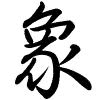
N3Tiểu học 5Tần suất: #494
Số nét12 nét
Thuộc bộ thủ
Loại chữPictograph
Cấu trúc

Thứ tự nét & Thư pháp
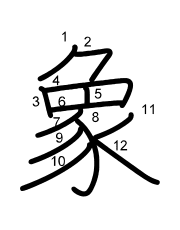
Thứ tự nét chữ 象

Sơ đồ thứ tự viết các nét chữ Kanji.
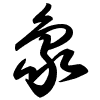
Biến thể Thư pháp cổ phong
Hành thưHành thư
Thảo thưThảo thư
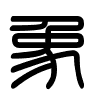
Triện thưTriện thư

Thông số Unicode & Kỹ thuật

Unicode HexU+8C61
Unicode Decimal35937
Mã Braille (6 chấm)⠨⠳⠃
Mã Braille Kantenji⢵⢈

Đa ngôn ngữ & Biến thể

Phiên âm Pinyin tiếng Trungxiàng
Phiên âm Hangul tiếng Hàn
Phiên âm Hán Việttương, tượng
Giản thể
Phồn thể

Phiên âm Hán Việt

tương, tượng
Các ý nghĩa đầy đủelephant; pattern after; imitate; image; shape; sign (of the times); phenomenon
Ý nghĩa chính thường dùngelephant; phenomenon

Cách đọc

Âm On Katakana

ショウ、ゾウ

Chi tiết: ショウ(漢)、ゾウ(呉)

Thống kê tần suất dùng:ショウ(88%), ゾウ(12%)

Âm Kun Hiragana

None

Chi tiết: かたど(る)、かたち

Phân tích cấu trúc & Bộ phận

Thành phần cấu tạo
Từ các bộ thủ
Là thành phần trong các chữ Kanji khác

Các chữ dễ nhầm lẫn

Các chữ Kanji có cấu trúc hoặc nét viết tương tự:

Câu ví dụ minh họa

(しろ)いガラスに、(いく)(しょく)かの(いろ)ガラスが(はい)り、かわいらしい(いんしょう)(しあ)がりました。

To the white glass, I added glass of various colours, producing a pretty feel.

Kanji trong câu
Độ khóLớp 6 (Tiểu học)
Từ chính入る
Trợ từ
(げんだい)(ちゅうしょう)()(とく)にモンドリアンが(りかい)(がた)い。

I have difficulty understanding abstract modern art, especially Mondrian.

Độ khóLớp 10 (THPT)
Từ chính理解
Trợ từ
(とう)(ぞう)がそこで()られた。

An elephant was hunted there.

Kanji trong câu
Độ khóLớp 12 (THPT)
Từ chính狩る
Trợ từ
(ひひょう)()はこれまでに()べた(とくちょう)づけはすべて(ひじょう)(ちゅうしょうてき)であると(はんろん)するかもしれない。

Critics may argue that all the foregoing characterizations are very abstract.

Độ khóTrên THPT
Từ chính反論
Trợ từ
もちろん、(じっさい)に「はやぶさ」が(たいよう)(ちか)づいているわけではなく、()のように(ちきゅう)から()(たいよう)(はんたい)(がわ)(いち)するだけですが、このような(げんしょう)を「(ごう)」と()びます。

Of course "Hayabusa" is not actually closing in on the Sun, it is just positioned as in the figure so that, seen from the Earth, it is on the opposite side of the Sun; this is called 'conjunction'.

Độ khóLớp 9 (THCS)
Từ chính位置
Trợ từ
トーテムポールと()ばれるこれらの(はしら)は、(すうはい)(たいしょう)として、あるいは(てき)(おどろ)かせるために(つく)られたと(かんが)えられている。

These poles, called totem poles, are thought to have been worshipped or constructed for frightening enemies.

Độ khóTrên THPT
Từ chính作る
Trợ từ
『いい(ひと)』とは、(おんな)()(れんあい)(たいしょう)にならない(おとこ)(あらわ)(とき)使(つか)(ことば)だ。

Nice person, that's the word girls used to call men to indicate that they aren't possible objects of romantic interest.

Độ khóLớp 8 (THCS)
Từ chính使う
Trợ từ
『いい(ひと)』とは、(おんな)()(れんあい)(たいしょう)にならない(おとこ)(あらわ)(とき)使(つか)(ことば)だ。

"Nice person," that's the word girls used to call men to indicate that they aren't possible objects of romantic interest.

Độ khóLớp 8 (THCS)
Từ chính使う
Trợ từ
(わたし)たち(にんげん)(あたま)(けいけん)(ひょうしょう)()える。

Our minds transform experiences into symbols.

Độ khóLớp 10 (THPT)
Từ chính変える
Trợ từ
ヨーロッパの(しゅよう)(とし)(おお)くはドーナツ()(げんしょう)(なや)まされている。

Many of Europe's metropolises are plagued by the doughnut phenomenon.

Độ khóTrên THPT
Từ chính悩ます
Trợ từ
ダーウィンの(かんが)えをこのように(かいてい)したことは(がくもんてき)(たちば)からの(こうげき)(たいしょう)となった。

This revision of Darwin's ideas came under fire from academic positions.

Độ khóLớp 9 (THCS)
Từ chính改訂
Trợ từ
その(かがくしゃ)は、(さいしん)(かがく)(ちしき)()らしてその(きみょう)(げんしょう)(せつめい)した。

The scientist explained the strange phenomena in the light of recent scientific knowledge.

Độ khóLớp 11 (THPT)
Từ chính照らす
Trợ từ
(たなか)(ぜん)(がいしょう)(こうてつ)(つづ)(せいじ)(こんらん)がその(しょうちょう)である。

The dismissal of foreign minister Tanaka is symbolic of the continuing political turmoil.

Độ khóLớp 10 (THPT)
Từ chính続く
Trợ từ
(じしょう)として(かんたん)なことを、いかにも(むずか)しそうに(ひょうげん)する(ひと)はあまり(あたま)がよさそうではない。

A person who makes an easy matter sound difficult does not seem to be so smart.

Độ khóLớp 9 (THCS)
Từ chính表現
Trợ từ
(ひひょう)()はこれまでに()べた(とくちょう)づけはすべて(ひじょう)(ちゅうしょうてき)であると(はんろん)するかもしれない。

Critics may argue that all the foregoing characterizations are very abstract.

Độ khóTrên THPT
Từ chính述べる
Trợ từ